
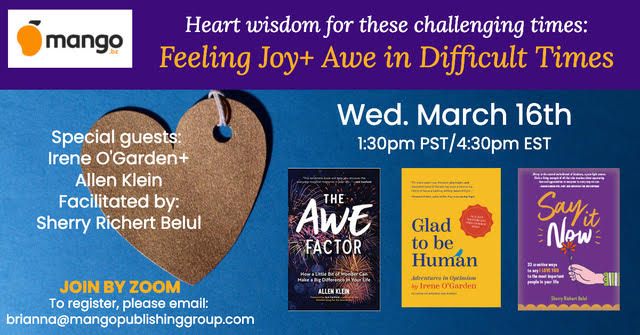
Wednesday, March 16th, 2022
Heart Wisdom Panel:
Feeling Joy + Awe in Difficult Times with Sherry Richert Belul, Allen Klein, and Irene O’Garden
1:30 pm / PT
During the pandemic, we saw the ways that depression and mental health impacted so many people of all ages. Over the last weeks as the violence in Ukraine has continued, it has added to an already-heavy sense of despair in the world.
People need to feel some relief from the grief, fear, and discouragement. We need to be uplifted and reminded of our spirits.
Cultivating a sense of joy and awe can be a great addition to our self-care practices during this time in the world when so many people are filled with grief, fear, disappointment, and heartbreak.
Join us at this week’s Mango Publishing Author Panel to participate in a conversation about ways to uplift ourselves and to bring more joy and awe to others, as well.
Our guest authors, Irene O’Garden (“Glad to Be Human”) and Allen Klein (“The Awe Factor”) will share their own stories and unique ways of living in joy and awe. Everyone who attends is invited to join the conversation if you wish. The panel is facilitated by Sherry Richert Belul (“Say it Now.”)
Mango Author Panels are a great way to get a behind-the-scenes look at the publishing world and what goes on in authors’ heads. They are always interactive, often intriguing, and especially warm and inspiring.
This event is free. However, registration is required. Please use the form below and the Zoom link will be sent to you upon registration.
**Author Bios**

Author Irene O’Garden (https://ireneogarden.com/) is an Off-Broadway playwright, an award-winning poet, a memoirist, and a Pushcart Prize-winning essayist whose latest book is “Glad to Be Human: Adventures in Optimism.”
 Through his books and keynote presentations, Allen Klein (https://www.allenklein.com/), the world’s only “Jollytologist”, shows people worldwide how to find humor and positivity in their not-so-funny stuff. Allen is author of numerous books, including “The Lighten Up Book” and, “The Awe Factor: How a Little Bit of Wonder Can Make a Big Difference in Your Life.”
  Sherry Richert Belul (simplycelebrate.net), author of “Say it Now: 33 Creative Ways to Say I Love You to the Most Important People in Your Life,” is founder of Simply Celebrate, a business dedicated to helping people live colorful, connected, creative lives of love and appreciation.
 Register for the Heart Wisdom panel below:
Sorry! Registration is closed, so we can manage the list of attendees.

 BJ Gallagher (
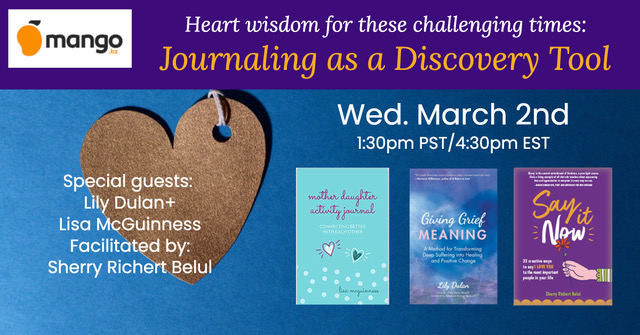
 Lily Dulan, author of “Giving Grief Meaning,” is an MFT Psychotherapist with a master’s degrees in Psychology, Creative Writing and Teaching. She is a certified Heart of Yoga Teacher and the founder of The Kara Love Project who drew on her studies of both Eastern and Western disciplines to create a heart centered system of healing and moving through trauma that she calls The Name Work®.

 Mitzi Szereto (
 Joan Renner
  Cathy Pickens (

 Friday, February 11th, 2022
 Dr. Anniqua Rana’s debut novel,
  Selma Tufail, an artist, has always navigated through the worlds of literature, art, and education. Life’s journeys have taken her around the world where she has taught, written, and created art — in Spain, Qatar, the U.A.E. the U.S, and Pakistan. She was awarded the Order of Civil Merit, the highest civilian award of Spain. The author and illustrator of
 Emily Thiroux Threatt:



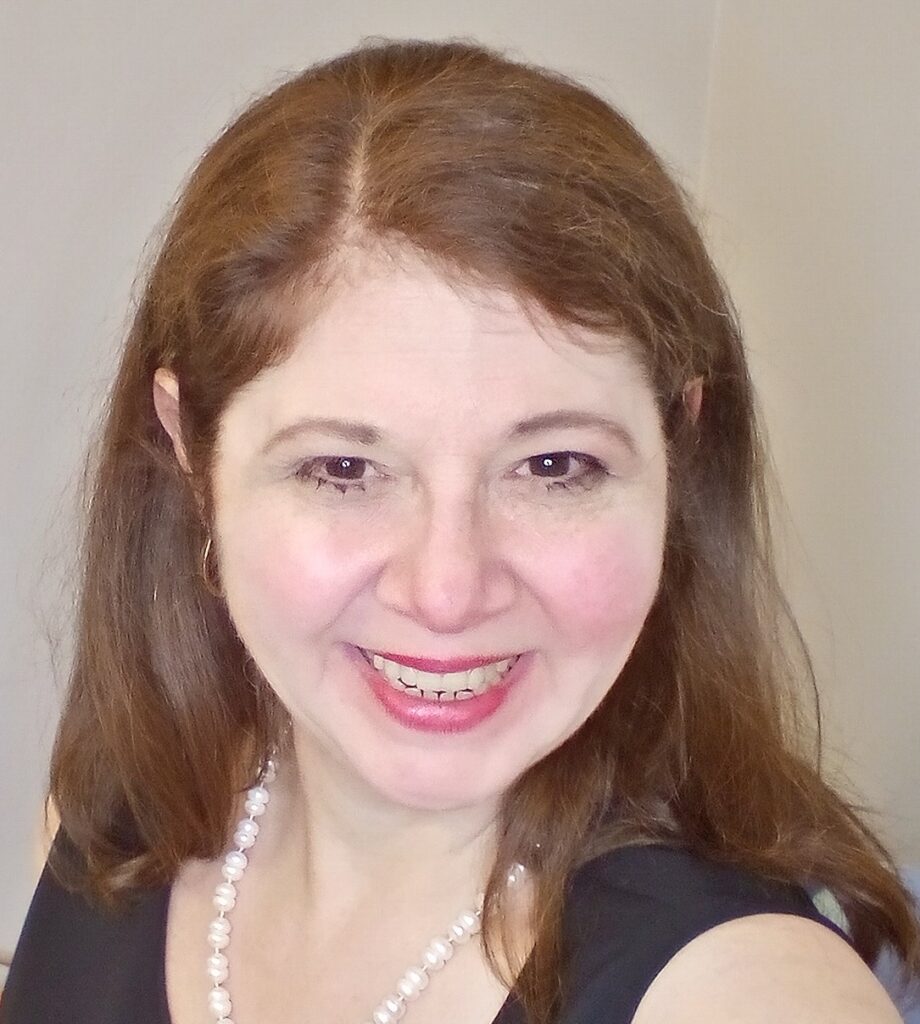 About Deb: Goal-Setting expert Debra Eckerling is the author of the award-winning
 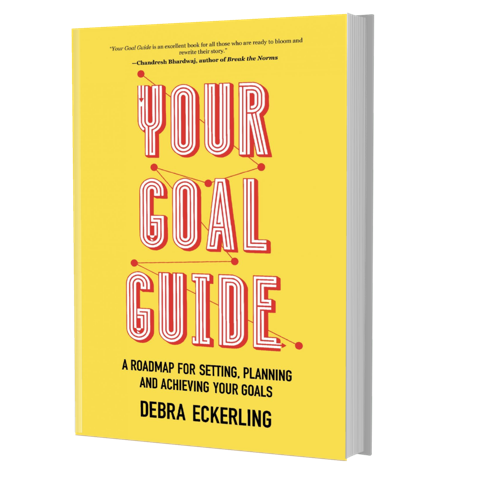 About the Book: One of the biggest reasons goals fail is that people often don’t put enough thought into what they really want before diving in. Your Goal Guide by Debra Eckerling starts with that first, crucial step: figuring out your goals and putting a plan in place. Eckerling presents readers with her own tested and proven method: the D*E*B METHOD®, a brainstorming and task-based system, which stands for: Determine Your Mission, Explore Your Options, Brainstorm Your Path. Through a combination of writing exercises and systems, Eckerling provides readers with a process for making and setting goals that is stress-free, easy-to-manage, and even fun